


LHON and Charles Bonnet Syndrome
What is Charles Bonnet Syndrome?
Many individuals who are affected with LHON vision loss also experience Charles Bonnet Syndrome. Charles Bonnet Syndrome (CBS) is the experience of phantom images or hallucinations in people living with some form of acquired vision loss such as LHON. These images co-exist with one’s regular visual experience.¹ CBS is similar to “phantom limb syndrome” – when someone’s lost a limb yet has sensations as if their missing arm or leg were still there.
While the cause is not truly known, CBS is considered the brain’s response to the deterioration of vision.² Phantom images or hallucinations can take many shapes and forms. They may be simple or complex, static or moving, color or black and white. Sometimes they manifest as unusual visual perceptions, such as flashes of light. Other times they can be clearer than what one’s vision currently allows, or clear enough to look real.³
Many medical providers are unaware of this condition or do not discuss it with their patients with vision loss. Many people refrain from telling anyone about seeing these phantom images for fear of being labeled a certain way or diagnosed with a mental health disorder.⁴

Charles Bonnet Syndrome can be different for everyone. It can happen at certain times of the day or night, or present differently, whether your eyes are open or closed. You can see a bunch of dots and spots, or fully formed imagery like trees or faces. This is normal, and there are things you can do to manage it.
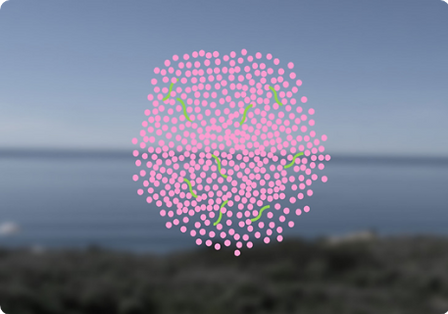
Photo rendering based on a report from a patient with LHON and CBS.
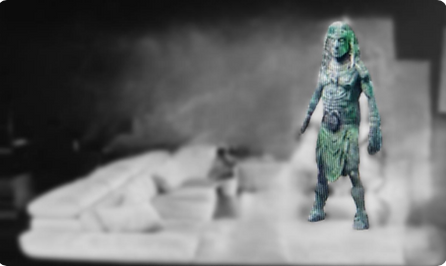
Photo rendering based on a report from a patient with LHON and CBS derived from a video by Vicky Hamilton, courtesy of The Queensland College of Art, Griffith University.
What does the research say?
There is research documenting the experiences of those with various eye diseases who also experience CBS,⁵,⁶ in addition to research specifically on CBS and those with eye diseases that cause central vision loss.⁷, ⁸ While some research documents cases of people affected with both LHON vision loss and CBS,⁹,¹⁰,¹¹ more data is needed, especially since it is underreported in clinical settings.³ Recent, unpublished data suggest that CBS is quite common among people affected with LHON vision.³ For most people experiencing both LHON vision loss and CBS, CBS symptoms endure for many years. However, few people with LHON have been advised on what CBS is, that it can be associated with LHON, and that both simple and complex images or flashes of light are normal symptoms.³
What treatments are available?
There are no specific treatments for CBS, but there are a range of options and techniques available to help people with CBS manage this condition. Seeking low vision services and experimenting with behavioral changes may be helpful for managing CBS symptoms. Ask about all available options when meeting with medical care providers.
What types of supports are available?
Just knowing that experiencing CBS is a normal, common side effect of any form of vision loss and that it is not associated with any form of mental decline can be reassuring on its own! It’s always beneficial to talk to others in the LHON Community who experience CBS. In addition, there are organizations that can assist with managing CBS symptoms, including:

Based in Australia, this organization’s mission is to: “assist people affected by Charles Bonnet Syndrome (including significant others); educate the general public about this condition; educate health care practitioners of its clinical profile; and research the cause/s, prevention, and treatment of Charles Bonnet Syndrome.¹²

Based in the UK, this organization aims to: “raise awareness of Charles Bonnet Syndrome, among healthcare professionals and out into the community; give information about CBS and create ways to offer comfort, reassurance, and practical advice to those who have developed the condition – and their families; and source funding for vital CBS research.¹³

The APH Connect Center is a service provided by the American Printing House for the Blind (APH), offering free information and resources to people who are blind or have low vision, aiming to help them achieve independence and success in life; it provides curated advice and support for children, parents, adults, and job seekers with vision impairments, along with their associated professionals.

Citations
¹ Charles Bonnet Syndrome: The Condition. Charles Bonnet Syndrome Foundation.
https://www.charlesbonnetsyndrome.org/index.php/cbs-information/the-condition
² FAQs – What is the cause of CBS? Charles Bonnet Syndrome Foundation. https://www.charlesbonnetsyndrome.org/index.php/cbs-information/faqs
³ Nguyen H, Kreimei M, Mollanji E, Poincenot L, Karanjia R. The Incidence and Characteristics of Charles Bonnet Syndrome in Leber Hereditary Optic Neuropathy in a Large Cohort. Oral presentation at: Association of Research in Vision and Ophthalmology Annual Meeting; May 2022; Denver, CO.
⁴ Charles Bonnet Syndrome: The Mystery. Charles Bonnet Syndrome Foundation. https://www.charlesbonnetsyndrome.org/index.php/cbs-information/the-mystery
⁵ ffytche DH & Howard RJ. The perceptual consequences of visual loss: ‘positive’ pathologies of vision. Brain. 1999. 122(2):1247–1260. doi:10.1093/brain/122.7.1247
⁶ ffytche DH. Visual hallucinations in eye disease. Current Opinion in Neurology. 2009. 22(1): 28–35. doi:10.1097/WCO.0b013e32831f1b3f
⁷ Cohen SY & Le Gargasson JF. Adaptation to central scotoma. III. Visual hallucinations and Charles Bonnet syndrome. Journal Français d’Ophtalmologie. 2006. 29(3):329–335. doi:10.1016/s0181-5512(06)73794-9
⁸ Abbott EJ, Connor GB, Artes PH, Abadi RV. Visual Loss and Visual Hallucinations in Patients with Age-Related Macular Degeneration (Charles Bonnet Syndrome). Investigative Ophthalmology & Visual Science. 2007. 48(3):1416–1423. doi:10.1167/iovs.06-0942
⁹ Santos-Bueso E, Sáenz-Francés F, Porta-Etessam J, García-Sánchez J. Charles Bonnet syndrome triggered by brimonidine in a patient with Leber’s hereditary optic neuropathy. Revista de Psiquiatría y Salud Mental (Barc.). 2014; 7:152–153. doi:10.1016/j.rpsmen.2014.06.001
¹⁰ Kolarova H, Catarino CB, Priglinger C, Klopstock T. Charles Bonnet syndrome in Leber’s hereditary optic neuropathy. Journal of Neurology. 2019. 266:777–779. doi:10.1007/s00415-019-09205-3
¹¹ Vacchiano V, Tonon C, Mitolo M, Evangelisti S, Carbonelli M, Ligouri R, Lodi R, Carelli V, La Morgia C. Functional MRI study in a case of Charles Bonnet syndrome related to LHON. BMC Neurology. 2019; 19:350. doi:10.1186/s12883-019-1579-9
¹² Charles Bonnet Syndrome Foundation (CBSF): Mission Statement. Charles Bonnet Syndrome Foundation. https://www.charlesbonnetsyndrome.org/index.php/about-us/our-mission
¹³ Esme’s Umbrella: What We Do [Home page]. Esme’s Umbrella.
https://charlesbonnetsyndrome.uk
This document should be considered general information only and should not be considered medical guidance or professional advice. Always direct any questions concerning your personal health to your doctor or another appropriate health care professional.
July 2026
