

Explaining LHON

Everything about LHON is confusing…even its name! Leber Hereditary Optic Neuropathy is usually referred to by its initials; “L-H-O-N.” It is also referred to simply as “Leber’s” (pronounced LAY-ber), based on the name of the German doctor (Theodore Leber) who, in 1871, described several patients with the disorder. Dr. Leber’s name is also associated with a completely different genetic eye condition with a different pattern of vision loss called Leber Congenital Amaurosis (LCA). It’s important to be sure you’re talking about the “right” disease when reading or hearing about “Leber’s.”
Many medical challenges are immediately understood by the general public. With a diagnosis of cancer or Alzheimer’s, for example, people generally have a sense of the situation. LHON is different since most people have never heard of it, nor have they had any interaction with anyone with severe vision loss. Blindness is usually thought to be an all-or-nothing condition, so those with LHON find themselves explaining repeatedly what they can and cannot see, and how they’ve lost central vision but can get around using peripheral vision. Macular degeneration is a very different eye condition, but the impact on vision is similar to LHON and it’s more common, so that can be a helpful comparison.
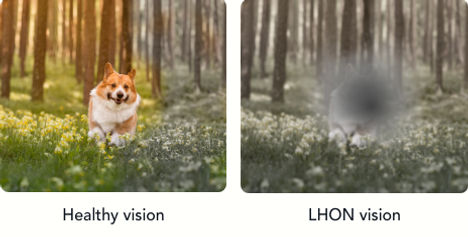
People often ask if you can correct the problem by wearing glasses or having an operation to “fix” the eyes. With LHON the eyes are working fine, the problem is with the optic nerves that transmit information between the eye and the brain, so glasses are not helpful and no operation is possible. The retinal ganglion cells (RGCs) and their axons that form the optic nerves become unhealthy and atrophy. It’s like a TV cord that’s become frayed so the signal doesn’t work. Since optic nerve cells can’t regenerate, the “cord” can’t be fixed. In some cases, the optic nerve cells don’t die, they’re just sick, hence in those cases there may be partial vision recovery.

People affected by LHON are often told they “don’t look blind.” If they don’t use a cane or a guide dog, people may not realize or believe they have a vision issue. When people walk by and the person with LHON vision “ignores them,” or doesn’t say “hi” back because they can’t see the person’s face to know who they are, it’s awkward for everyone. Teaching friends to say “Hi, this is so-and-so,” upon approaching someone with LHON vision, and encouraging other friends “in the know” to tell the person with LHON vision someone they know is approaching, can be a big help in overcoming this social awkwardness.
Since those with LHON vision usually have some peripheral vision, they tend to use that peripheral vision to see. They may look straight ahead so that others don’t find their gaze disconcerting, yet will look upward or to the side to see what they can using peripheral vision.

Truly looking straight ahead using LHON vision

Looking straight ahead trying to appear fully sighted
In social situations it’s difficult to know who to talk to, and impossible to make eye contact or “read” another person’s facial expressions. This can cause a sense of apprehension or unease and the more that sighted supporters can help out, the better.


